
For years, the rhythm of the data centre was predictable. You planned your north-south traffic flows, configured BGP and OSPF, optimised your spine-leaf architecture, tuned your spanning tree (or thanked the gods for EVPN-VXLAN rendering it obsolete), and ensured your virtualized workloads had clean paths to storage and the WAN.
Then came the AI tsunami.
Suddenly, boards and executive teams everywhere are chanting a single directive: “We need an AI strategy.”
If you are a traditional network engineer, it is easy to feel a mild sense of alienation in this new era. The conversation is dominated by data scientists tweaking hyperparameters, software engineers containerising workflows, and infrastructure vendors shouting about GPUs, tensor cores, and cluster compute scales. It feels like networking has been relegated to a mere utility – a plumbing pipe that just needs to be wide enough to carry the data.
Here is the hard truth: That perspective couldn’t be further from reality.
In the age of enterprise AI, the network is the computer. And traditional network engineers aren’t being left behind – they are the most critical bottleneck-solvers in the entire tech stack.
The AI infrastructure crisis: Why your code doesn’t matter if your fabric drops packets
When people think of AI bottlenecks, they think of compute. They think about NVIDIA H100s, B200s, and clusters running dry because a model is taking too long to converge. But look under the hood of a distributed training run, and you’ll find a massive networking challenge.
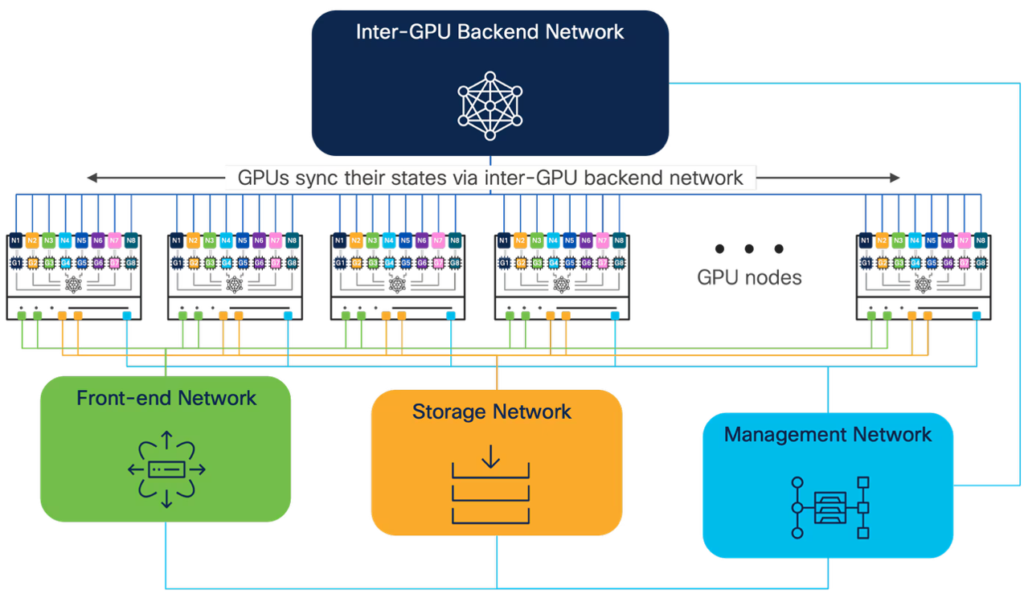
Unlike traditional enterprise workloads characterised by heavy north-south traffic (client-to-server), AI training and inference rely overwhelmingly on east-west traffic and multiple dedicated networks. Thousands of GPUs must communicate continuously, synchronizing weights and gradients via collective operations like All-Reduce and All-To-All. This new AI data centre (AI Factory) architecture is illustrated in the following figure.
If a single packet is dropped, or if microbursts cause head-of-line blocking, the entire GPU cluster stalls. Millions of dollars of high-performance compute sit idle waiting for a single dropped TCP/IP acknowledgment. Standard TCP is too sluggish, modern AI fabrics demand RDMA over Converged Ethernet (RoCEv2), requiring a completely overhauled understanding of lossless networking, Priority Flow Control (PFC), Explicit Congestion Notification (ECN), and advanced dynamic load balancing.
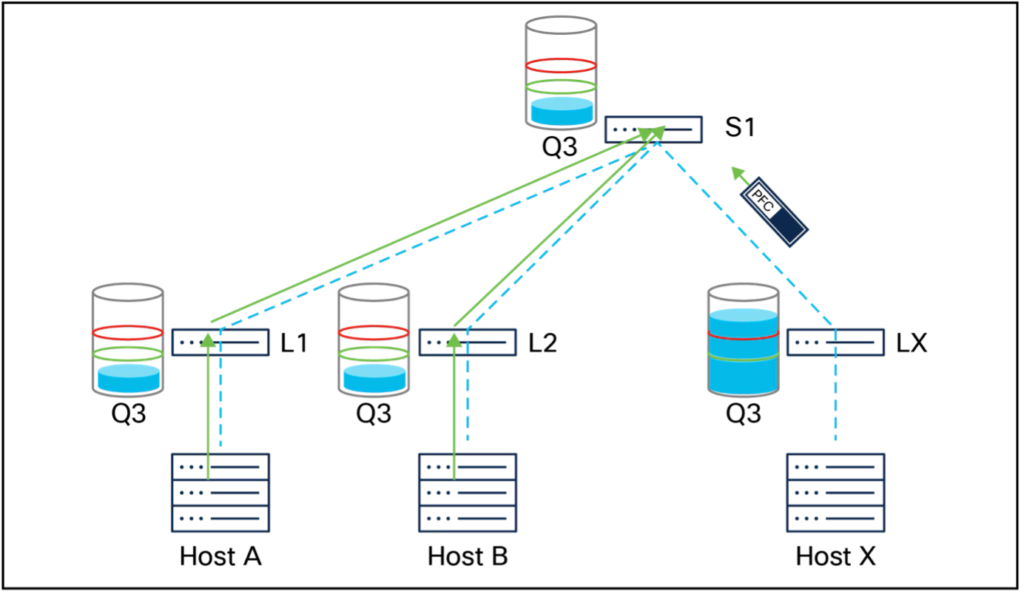
Did you know? Even if you have non-oversubscribed fabric built with line-rate data-centre grade switches, you can still have congestion and hazardous packet drops? The answer lies in also having a proper hardware-based packet-level load-balancing technique (for starters) … Read on!
Data scientists understand algorithms, nor do they understand how to tune buffer allocations or configure adaptive routing and load-balancing across a multi-tier leaf-spine fabric. That is where you come in.
The bridge: Why Cisco’s DCAIE matters now
This exact friction point is why specialised training like Cisco’s AI Solutions on Cisco Infrastructure (DCAI) and DCAIE (DCAI Essentials) courses have become essential.
For a traditional network engineer, DCAI(E) isn’t just another product badge to add to the resume – it’s a translation layer. It bridges the gap between decades of hard-earned networking discipline and the brutal physical realities of modern AI workloads.
The course tackles the structural shift required to build true AI-ready fabrics on Cisco infrastructure, focusing on:
- Designing lossless fabrics: Moving past basic high-availability into zero-drop networks capable of sustaining high-throughput, low-latency GPU cluster communication.
- Operationalising telemetry and automation: Leveraging tools like Cisco Intersight and Nexus Dashboard to track microbursts, queue depths, and congestion in real-time before they tank a multi-day model training epoch.
- Aligning compute with fabric: Understanding how server topology, network interface cards (NICs), and switch architectures intersect to maximise throughput.
The career pivot: Stop fearing AI, start understanding and architecting it
There is a quiet anxiety rippling through IT departments right now. Engineers wonder if automation, SDN, and AI agents will render human networking skills obsolete.
The opposite is happening. While basic configuration and provisioning are increasingly automated, architecture and telemetry troubleshooting at scale are harder than ever. An AI cluster doesn’t care about your static configuration templates; it punishes subtle architectural flaws with degraded performance and wasted millions.
By stepping up to learn how AI fabrics operate, traditional network engineers transform themselves from reactive box-configurators into indispensable enterprise architects. You already know how packets move, how loops happen, and how to design for resilience. Learning how to scale that foundation for AI is the highest-leverage career move you can make today.
The AI gold rush is here. The people selling the pickaxes aren’t the prompt engineers – they’re the infrastructure architects who make sure the machines can actually talk to each other.
