Cisco URWB – it’s about productivity
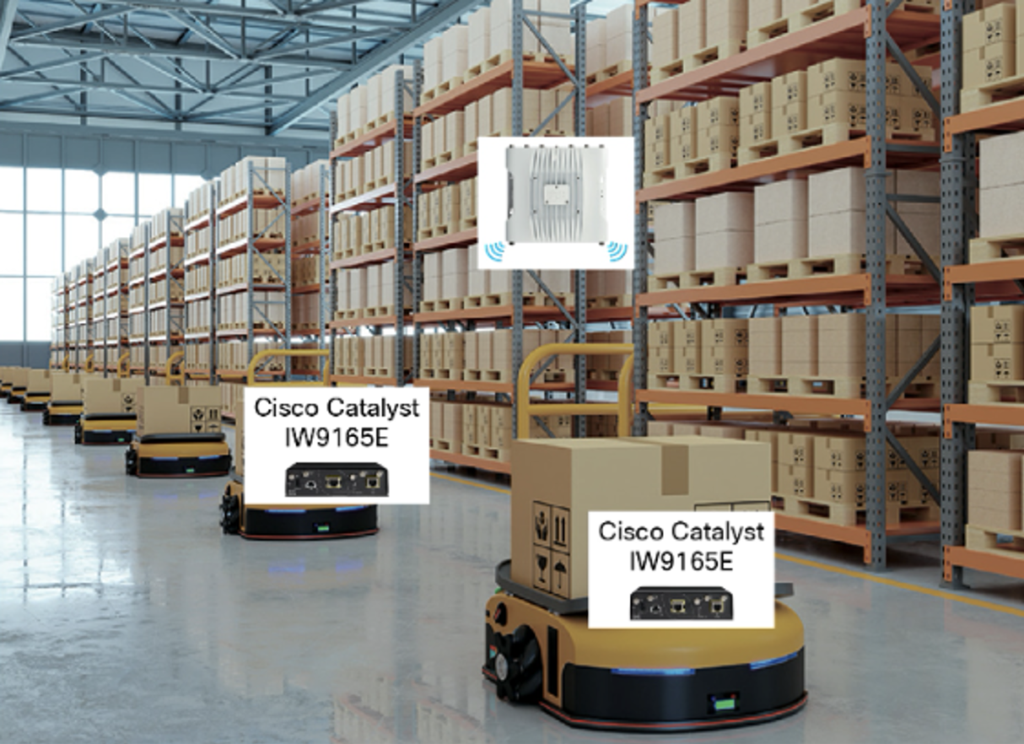
How? By connecting AGVs (Automated Guided Vehicles) and AMRs (Automated Mobile Robots) much better than over Wi-Fi, to work reliably 24/7 instead of humans, without fatigue and errors. AGVs also drive profitability since they lower labour costs by automating assembly flows and eliminating bottlenecks.
Several well-known manufacturers have recently started to deploy automatisation solutions involving AGVs. A few of them have recently aggressively integrated AGVs into their global production. AGVs operate on fixed magnetic or optical paths and require external physical infrastructure. If they come across an obstacle, they would stop and wait. They would not calculate alternative routes around obstacles like AMRs would. An example of a possible Cisco URWB (Ultra-Reliable Wireless Backhaul) connectivity of such appropriate types of AGVs in factories are AGVs produced by Swedish Elektroautomatik. In such a use case, URWB would be necessary to completely exclude any brief loss of control of the AGV. Without URWB, it would not be able to locate an obstacle, or it would stop without a continuous control, due to a sub-second network disconnection of Wi-Fi.
How PROFINET is transmitted over Cisco URWB
Transmitting PROFINET wirelessly presents a challenge, because it requires deterministic, real-time responses.
PROFINET operates in two main ways across Cisco URWB:
- TCP/IP channel for non-critical data – diagnostics, parameter changes, and device management use standard TCP/IP and transmit seamlessly over URWB without requiring special plugins.
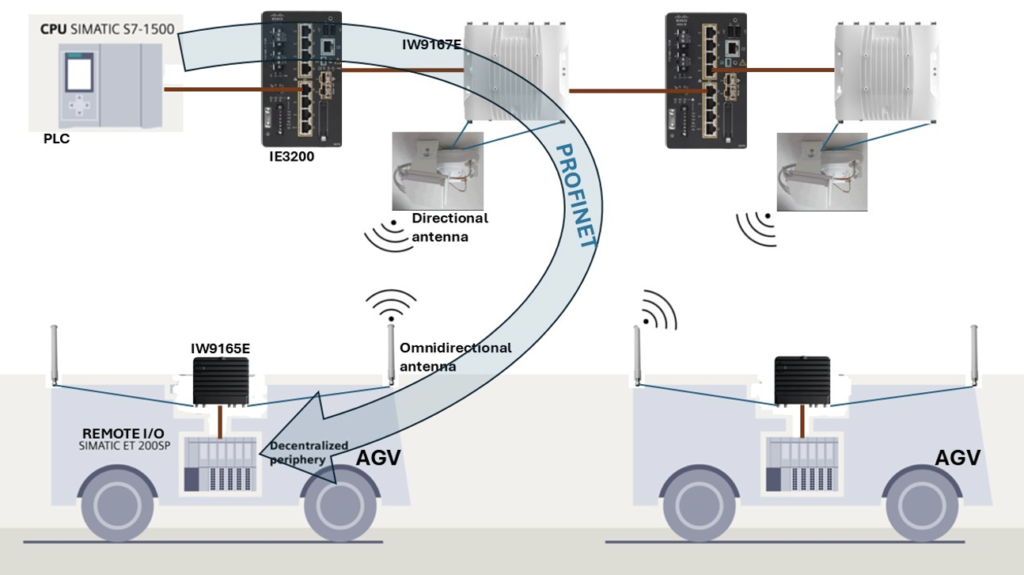
- Real-Time (RT) and Isochronous Real-Time (IRT) channels – for the most demanding handshaking cyclic I/O data and emergency safety messages, PROFINET bypasses TCP/IP and relies on a dedicated EtherType (Layer 2) frame. To ensure these packets are not dropped or delayed, Cisco URWB utilises the Ethernet type filter which explicitly allows PROFINET frames transmission. Besides, the industrial switches IE3200 and interconnecting URWB Access Points also support dedicated PROFINET plugins (such as Conformance Class B plugin support on hardware).
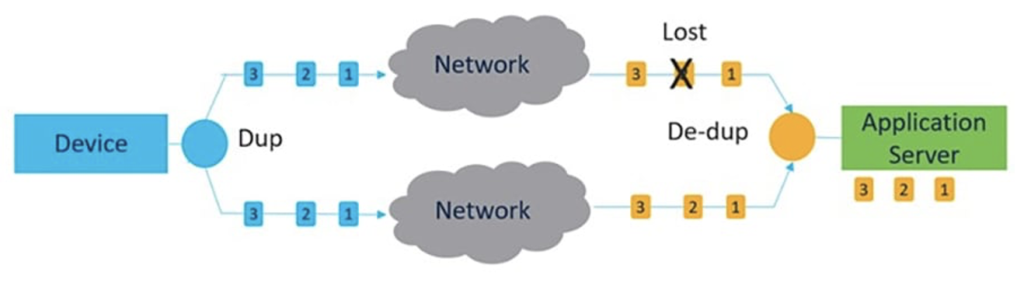
This enables the URWB network to prioritise, encapsulate, and securely forward these Layer 2 PROFINET frames using advanced Quality of Service (QoS) and rapid, redundant multi-path forwarding technologies. Even in case these critical frames are lost for any reason (reflection or interference), there is an URWB feature called Multipath Operation (MPO) that duplicates chosen frames (e.g. PROFINET) over another radio connection and deduplicates them once received.