I studied Physics. I work in the Networking Industry. These two facts together have guided my interest into particular areas of technology over the years. First Wireless. Now Quantum Computing. Both require a fair understanding of the physics laws behind them for their correct application to real use cases.
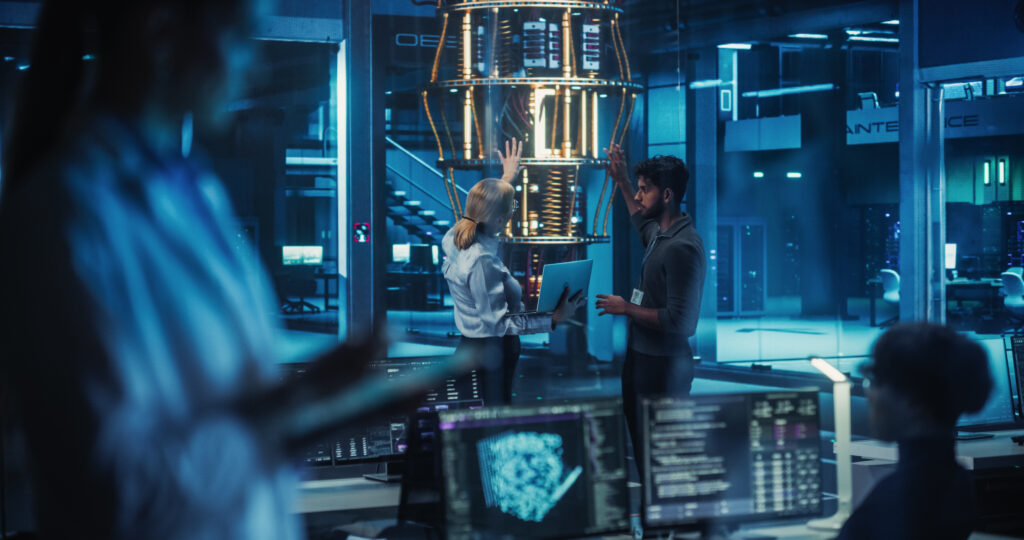
Following my physicist nose, I recently stumbled onto a session at Cisco Live Amsterdam* that inspired me to learn more about Quantum Computing and tackle this blog series. My intention is to cover the concepts and current status of quantum computing technology in a simple but accurate way. I can’t promise easy, but hopefully I can avoid complicated.
The concepts behind Quantum Computing have been around for many years (20+ years ago I learned about qubits in university). And in recent years we have started to see real technology created based on those concepts. In the networking industry, we have started planning accordingly. But, before I get into the thicket of it, let’s clarify a few things.
*If you are interested, find session BRKETI-1401 by Tim Szigeti here, superb session and speaker.
What is Quantum?
Quantum Physics is a part of science that deals with the smallest particles we know, the ones we have not (yet) managed to break into smaller components. These particles are the basic building blocks of, well, everything. Some of these smallest particles you may know, like electrons and photons, and some others you may not know, as quarks and neutrinos. They exist in a realm where the regular laws of physics do not suffice. Energy is given or taken in discreet quantities (or quantus) instead of in continuous flows, and particles are subject to forces that we do not experience in a macroscopic world. A new rulebook had to be created to deal with this realm: Quantum Physics.
Quantum Physics introduced new concepts that in many cases are counter-intuitive and sometimes seem to contradict more traditional physics laws (but they actually don’t). And precisely because these are unfamiliar concepts, most of us find it difficult to grasp how they are implemented in technology.
“Those who are not shocked when they first come across quantum theory cannot possibly have understood it.” – Niels Bohr
The age of Quantum Computing
Years after the basic principles of Quantum Physics were postulated, we started playing with their application to the real world. MRIs in medicine and GPS location both use quantum principles. The concept of quantum bits was first postulated in the early 1980s.
And now, Quantum Computers are here. Not on your desk, no, not yet. For starters, most of them are too big (the size of a car). Some more “portable” models are starting to pop up, but you cannot yet add them to your Amazon cart. Most of the space used by a quantum computer is occupied by the cooling system. Which brings us to the next problem faced if you want to keep one at home…
Most quantum computers require a near absolute zero degrees operating temperature (absolute zero is 0° Kelvin = – 273° Celsius). In fact, they run at around 10 and 100 miliKelvins. That is very, very cold. In fact, it is colder than outer space.
Development of Quantum Computers is ongoing, and it has become a bit of a race to create the “biggest and fastest” Quantum Computer. The more powerful a Quantum Computer is (i.e. the more qubits it has), the more operations it can process and the fastest it can solve complicated calculations. We are already starting to see the use of these devices to model complex simulations of weather, molecular engineering and financial models. We also see their use in optimisations, pattern recognition, AI, and cryptography.
Not every problem can be solved faster or even solved at all with a quantum computer. But in some areas, quantum computers have opened the doors to postulate and solve questions that were impossible to address with traditional computers.
Over the next few blogs I will explain the basics of quantum computing, the effects on the security industry, and the future of quantum networking. If I’ve sparked your interests, keep on reading!
