
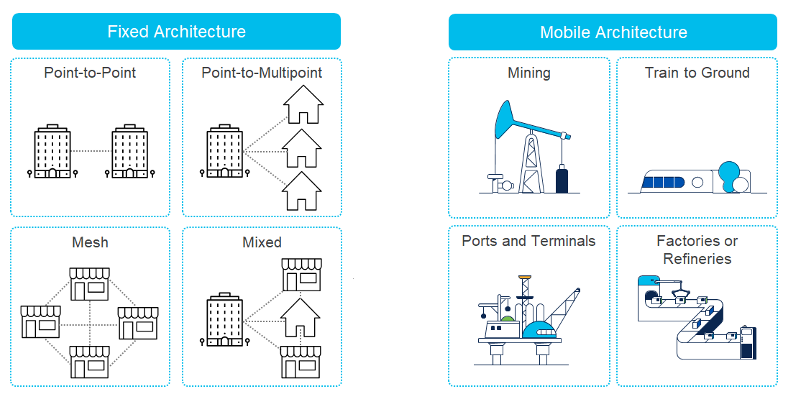
For anyone that has come across the environments where machines are constantly on the move—such as ship cranes in ports, dozers in mines, robots in factories—a common challenge probably sounds familiar. Similarly, if you needed to urgently provide a connection to a campus-distance, a wireless alternative “just like a fiber” is available.
Why Ultra-Reliable?
The main reason for considering Cisco Ultra-Reliable Wireless Backhaul (CURWB) is the smooth handling of the mobile client device handoff between Access Points (AP). This concept is specifically useful when you cannot afford any connection losses, that would make a robot “frozen” during its operation, or a crane stopping in the middle of the movement, or a metro’s door half-opening. Moreover, the same concept applies in the fixed solutions, instead of the fiber-optical connection. In order to decrease the cost and deployment time of the fixed solution, the CURWB solution might help.
What are the latest innovations?
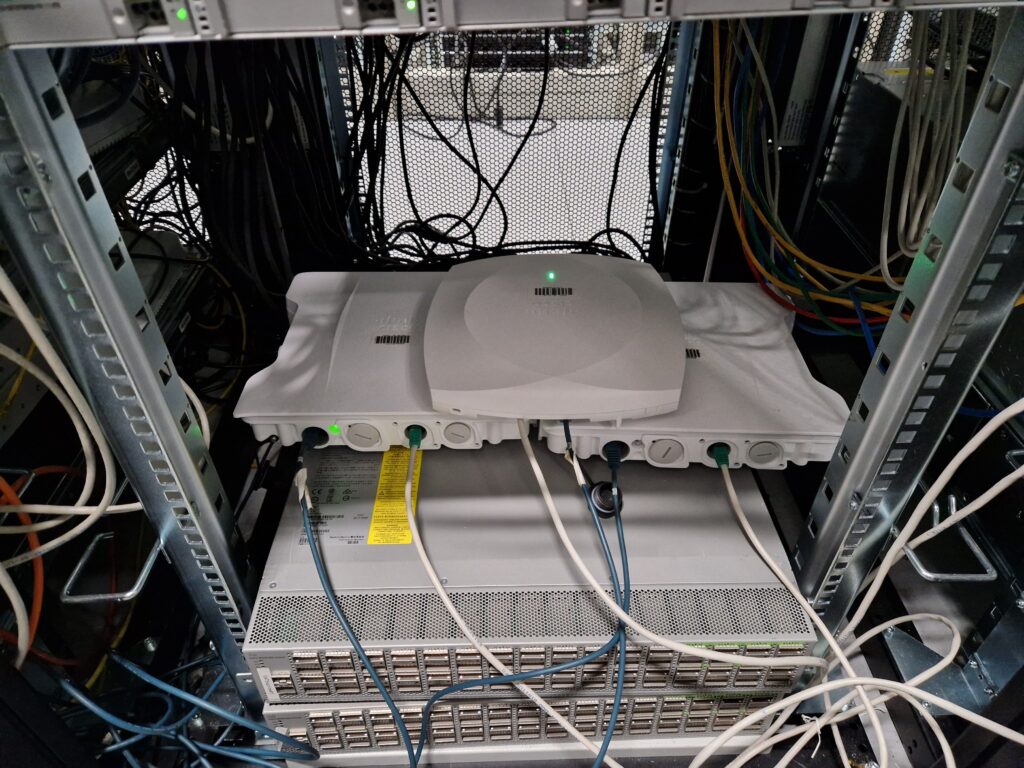
The latest features have introduced several improvements into the CURWB architecture. Many additional CURWB APs, besides the initial Industrial Wireless APs, are now available for the indoor, outdoor, and hazardous environments, for different frequency spectrums. Another great innovation is the dual support of CURWB & WiFi on the same AP. Previously, two separate APs had to be implemented to cover a distant area with WiFi signal. Consequently, to integrate such dual APs into Wireless Controllers (WLC), it is now possible to configure and control the CURWB functionality from the WLC. Such APs are compatible with the CURWB standalone APs. There are plans to add certain CURWB-related features to Catalyst Center.
Use cases
• Secure and smart cities: Transmission of the road and parking camera streaming connections
• Mass transit and rail: A very popular choice for securing an uninterrupted connection to the metro lines
• Ports and maritime: It connects moving machinery—such as stacking cranes and reach stackers
• Mining: Enables real-time control of unmanned trucks, drills, and excavators, removing personnel from dangerous areas
• Amusement parks: Parades in which floats move along the street, accompanied by synchronized lighting and music
• Government and military: Quickly bridges gaps in connectivity for temporary, or remote government sites, such as temporary clinics or disaster relief hubs
• Robotics and factory floor: A perfect fit, since no loss of the critical distant connection are allowed
• Airports: Unmanned people-moving operations, responsible for the transportation of millions of passengers annually
• Live events and broadcasting: Can provide connectivity to coordinate sound and lighting during live events, such as shows and concerts

Key technologies behind CURWB
Several advanced technologies enable CURWB to achieve its high reliability and performance.
- Make-before-break handoff – CURWB eliminates the problem of traditional networks by establishing a connection with the next AP before leaving the current one
- Multipath Operations (MPO) – Critical packets may be duplicated across different frequencies or access points and deduplicated if missing due to a hardware failure
- MPLS-over-wireless protocol – Each radio path uses a separate MPLS label, which optimizes a packet delivery over the best radio parameters
Why take the CURWB training?
As more industries adopt automation, robotics, and smart infrastructure, networks must become more reliable.
In the future, CURWB will play an important role in enabling smarter factories, more efficient ports, and increasingly automated transportation systems.
